
Add your previous GPA (for cumulative GPA)
What GPA do I need next term?
Work out your GPA for a semester, or your cumulative GPA across all your semesters. Choose a letter grade and the credits for each course and the calculator shows your GPA as you go. It handles Honors, AP and IB boosts for a weighted GPA, ignores pass/fail courses, and can tell you the GPA you need next term to reach a goal.
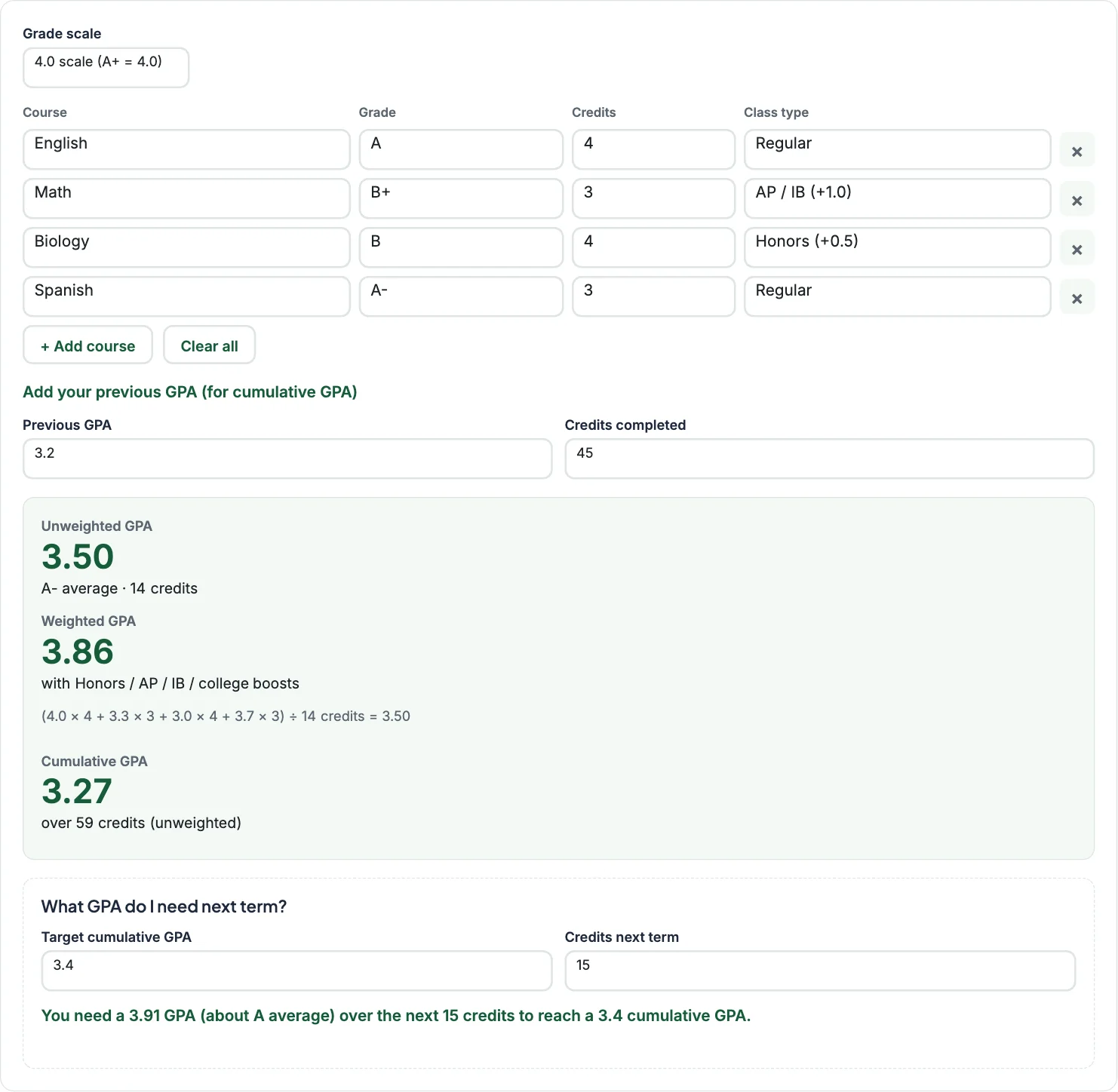
How to calculate your GPA
- Pick the letter grade for each course and enter its credits or hours. In most high schools every class is 1 credit; in college most courses are 3 or 4.
- Set the class type to Honors, AP, IB or college if your school gives those classes extra points. The calculator then shows both your unweighted and weighted GPA.
- To get your cumulative GPA, open “Add your previous GPA” and enter your GPA so far and the credits it covers.
- Use “What GPA do I need next term?” to plan for a scholarship, honors list or program cut-off.
How GPA is calculated
Each letter grade has a number of grade points (A = 4.0, B = 3.0, and so on). Multiply the points by the course credits, add them up, and divide by the total credits:
GPA = (points₁ × credits₁ + points₂ × credits₂ + …) ÷ total credits
Example
English A (4 credits), Math B+ (3 credits), Biology B (4 credits), Spanish A- (3 credits). That is (4.0 × 4 + 3.3 × 3 + 3.0 × 4 + 3.7 × 3) ÷ 14 = 49 ÷ 14 = 3.50.
Weighted vs unweighted GPA
An unweighted GPA uses the same 4.0 scale for every class. A weighted GPA gives extra points for harder classes, so an A in an AP class can count as 5.0. This calculator adds 0.5 for Honors and 1.0 for AP, IB and college or dual-enrollment classes, which is the most common system. An F never gets a boost. Colleges often recalculate GPA their own way, so it is worth knowing both numbers.
Cumulative GPA
Your cumulative GPA is not the average of your semester GPAs. It is weighted by credits: (previous GPA × previous credits + this term’s grade points) ÷ all credits. A 3.0 over 60 credits plus a 4.0 over 15 credits gives (180 + 60) ÷ 75 = 3.20, not 3.5.
GPA scale
| Letter grade | Percentage | GPA points |
|---|---|---|
| A+ | 97–100 | 4.0 (4.3 on some scales) |
| A | 93–96 | 4.0 |
| A- | 90–92 | 3.7 |
| B+ | 87–89 | 3.3 |
| B | 83–86 | 3.0 |
| B- | 80–82 | 2.7 |
| C+ | 77–79 | 2.3 |
| C | 73–76 | 2.0 |
| C- | 70–72 | 1.7 |
| D+ | 67–69 | 1.3 |
| D | 63–66 | 1.0 |
| D- | 60–62 | 0.7 |
| F | Below 60 | 0.0 |
This is the most common US scale. Your school may draw the lines a little differently, for example A from 90% instead of 93%, so check your syllabus or student handbook if a grade sits right on a boundary.
Pass/fail (P/NP) courses give you credits towards graduation but do not count in your GPA, so the calculator leaves them out.
What is a good GPA? The national average
In the US, the average high school GPA was 3.11 for students who graduated in 2019, up from 3.00 in 2009, according to the 2019 High School Transcript Study by the National Assessment Governing Board. So a 3.0 is roughly average, a 3.5 or higher is strong, and selective colleges usually look for 3.7 and above, often weighted.
GPA rose while test scores stayed flat, which is one reason colleges also look at course difficulty. Honors and AP classes on a weighted scale (5.0 for an A) show that, so use the weighted option above if your school reports it.
Frequently asked questions
Is a 3.5 GPA good?
Yes. A 3.5 is roughly an A-/B+ average and is above the typical US college average of about 3.1. Competitive programs and scholarships often look for 3.5 or higher.
What is the difference between the 4.0 and 4.3 scale?
The only difference is the A+. On a 4.0 scale it is worth 4.0, the same as an A. On a 4.3 scale it is worth 4.3. Choose the scale your school uses at the top of the calculator.
How do I convert a percentage to GPA?
Find your percentage in the scale table above. For example 88% is a B+, which is 3.3 grade points. To get the letter for a whole class from your scores, use the grade calculator.
How can I raise my GPA quickly?
Courses with more credits move your GPA the most, and early semesters move it more than later ones because fewer credits are behind them. The “What GPA do I need next term?” box shows whether your target is realistic.
Does this work for Indian CGPA?
Indian universities usually use a 10-point CGPA, which works differently. This calculator follows the US 4.0 system.
Sources
Checked in November 2026:
How to cite this tool
Using this tool for coursework, a report or research? You can cite it like this (APA 7th edition):
Kumar, M. (2026). GPA Calculator [Online tool]. FreeToolsLand. https://freetoolsland.com/gpa-calculator/
Related calculators
- SGPA and CGPA Calculator: SGPA from credits and grade points, and CGPA across semesters
- How to calculate grades, GPA and CGPA: the guide with worked examples for every method
- Test Score Calculator: marks or wrong answers to a percentage and letter grade
- Grade Calculator: weighted, letter or points grades
- Final Grade Calculator: the score you need on your final exam
- Percentage Calculator: turn a score like 42 out of 50 into a percentage
- CGPA to Percentage Converter: for a 10-point CGPA from an Indian board or university
- Age Calculator: exact age for admission and exam age limits
- All calculators