
If you still have 12% and 28% in your head as GST rates, you are not alone. Plenty of invoices, price lists and even billing software were set up around them for eight years. But since 22 September 2025, India has been on what everyone calls GST 2.0: a simpler system with two main rates, 5% and 18%, and a special 40% rate for a short list of luxury and “sin” goods.
Here is what changed, which everyday items moved to which slab, and how to work out GST on a bill under the new rates, with examples you can check yourself.
In this guide
- What is GST 2.0?
- New GST rates: the slabs at a glance
- Which items became cheaper under GST 2.0?
- What falls under the 40% GST rate?
- How to calculate GST at the new rates
- Quick comparison: old vs new rates
- Frequently asked questions
What is GST 2.0?
GST 2.0 is the name given to the rate overhaul approved at the 56th meeting of the GST Council on 3 September 2025 in New Delhi, chaired by Finance Minister Nirmala Sitharaman. The new rates came into force on 22 September 2025, the first day of Navratri that year.
In short:
- The 12% and 28% slabs were removed for most goods.
- Almost everything now falls under a 5% merit rate or an 18% standard rate.
- A 40% de-merit rate applies to a small set of luxury and harmful goods.
- Essentials that were already at 0% stayed there, and a few more were added, such as individual life and health insurance.
New GST rates: the slabs at a glance
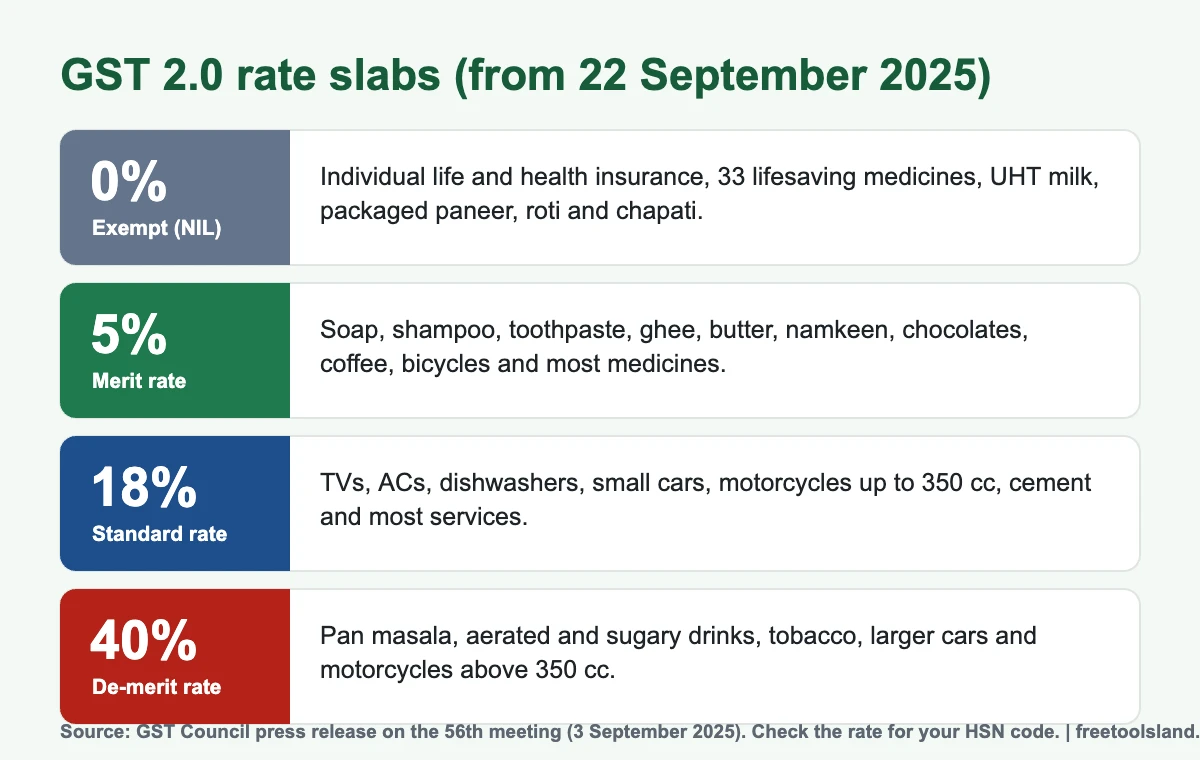
| Slab | What it covers | Examples |
|---|---|---|
| 0% (NIL) | Essentials and some services | Individual life and health insurance, 33 lifesaving medicines, UHT milk, paneer, roti and chapati |
| 5% | Merit rate for daily-use goods | Hair oil, shampoo, soap, toothpaste, toothbrush, butter, ghee, namkeen, chocolates, coffee, bicycles, kitchenware, most medicines |
| 18% | Standard rate for most goods and services | TVs, ACs, dishwashers, small cars, motorcycles up to 350 cc, cement, buses and trucks, most services |
| 40% | De-merit rate | Pan masala, aerated and sugary drinks, bigger cars, motorcycles above 350 cc, yachts and personal aircraft |
| 3% | Unchanged | Gold, silver and jewellery |
Which items became cheaper under GST 2.0?
The biggest winners are household goods. Most toiletries, packaged foods and kitchen items that sat at 12% or 18% moved to 5%. Butter, ghee, namkeen, chocolates and coffee are now 5%. Paneer and UHT milk went to nil, as did roti and chapati (paratha is at 5%).
Big-ticket items that used to be at 28%, such as air conditioners, televisions above 32 inches, dishwashers, small petrol and diesel cars and motorcycles up to 350 cc, dropped to 18%. Cement also moved from 28% to 18%, which matters to anyone building a house.
For many families the most useful change is insurance: premiums on individual life and health policies are now exempt from GST, where they used to attract 18%.
What falls under the 40% GST rate?
The 40% rate replaces the old 28% plus compensation cess on a narrow list of goods:
- Pan masala and similar products.
- Aerated, sugary and caffeinated drinks.
- Petrol, LPG and CNG cars above 1200 cc or longer than 4000 mm, and diesel cars above 1500 cc or longer than 4000 mm.
- Motorcycles above 350 cc.
- Yachts and aircraft for personal use.
Cigarettes and other tobacco products are a special case: they stay at their old rate plus compensation cess until the loans taken to pay states compensation are repaid, after which they move to the 40% slab.
How to calculate GST at the new rates
The formulas did not change, only the rates. To add GST to a price: GST = price × rate ÷ 100. To find the GST hidden inside a bill that already includes it: price before GST = bill ÷ (1 + rate ÷ 100).
Take a ₹590 bill at 18%. Dividing by 1.18 gives ₹500, so the GST is ₹90, split as ₹45 CGST and ₹45 SGST if the seller is in your state, or ₹90 IGST if they are not. The common mistake is to take 18% of 590 (₹106.20), which overstates the tax because the 590 already includes it.
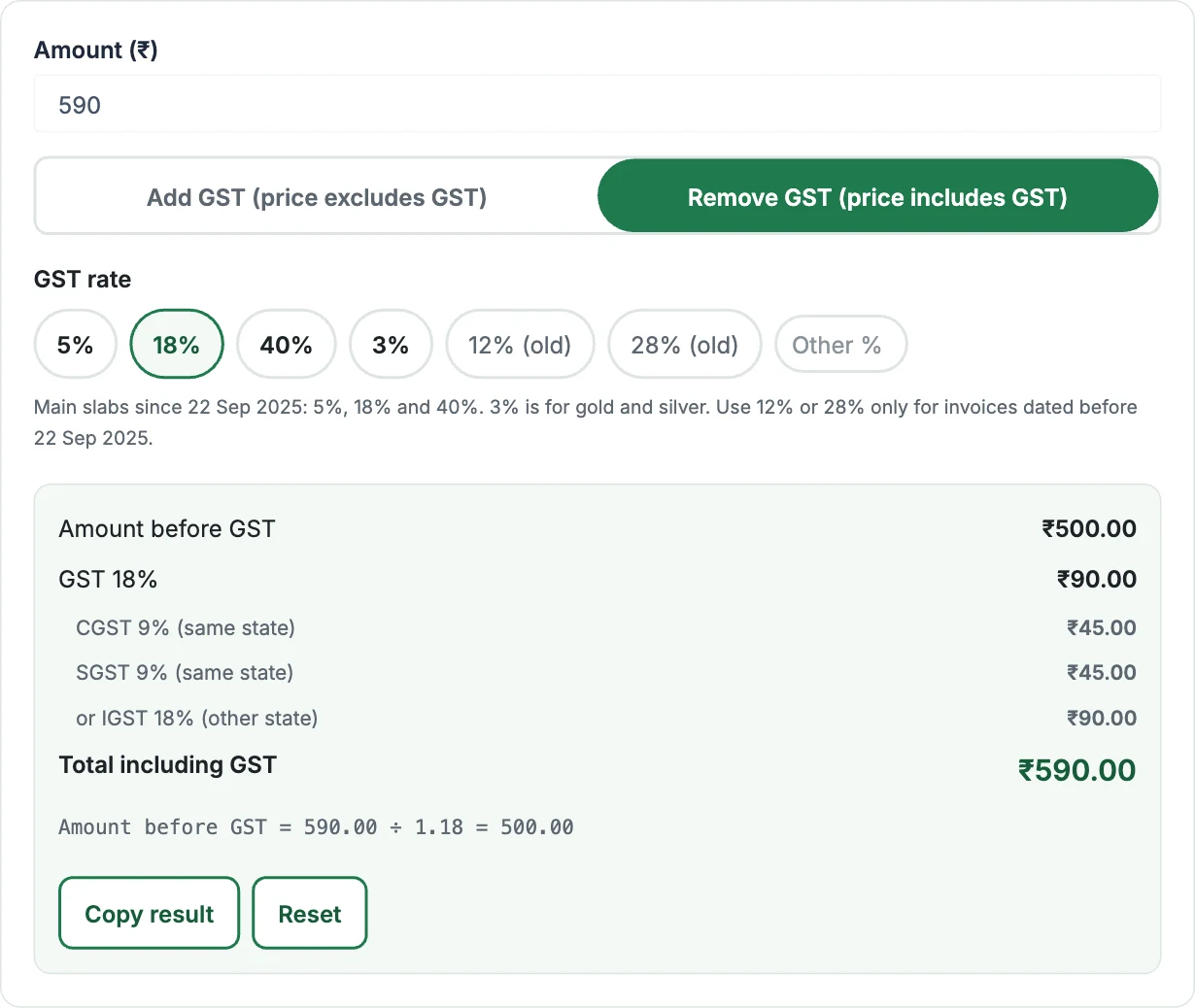
You can do this in the GST Calculator: type the amount, choose Add GST or Remove GST, and pick 5%, 18% or 40%. It also keeps the old 12% and 28% rates, which you will still need to check invoices dated before 22 September 2025.
Quick comparison: old vs new rates
| Item | Before 22 Sep 2025 | From 22 Sep 2025 |
|---|---|---|
| Shampoo, soap, toothpaste | 18% | 5% |
| Butter, ghee, cheese | 12% | 5% |
| Air conditioners, TVs over 32 inches | 28% | 18% |
| Small cars, motorcycles up to 350 cc | 28% | 18% |
| Cement | 28% | 18% |
| Individual health insurance premium | 18% | Nil |
| Aerated drinks | 28% + cess | 40% |
Need the maths behind it? Our guide on how to calculate percentage covers reverse percentages, which is exactly what removing GST is.
Frequently asked questions
Is 12% GST still applicable?
For most goods, no. Items that were at 12% moved to 5% or 18%. You still use 12% when checking or correcting an invoice dated before 22 September 2025.
When did the new GST rates start?
On 22 September 2025. Some procedural changes, such as simpler registration for small businesses, were scheduled from 1 November 2025.
What are the GST slabs now?
5% and 18% are the two main slabs, with 40% for luxury and harmful goods, 0% for exempt items and 3% for gold and silver.
Did GST on medicines change?
Yes. Most medicines are now at 5%, and 33 lifesaving drugs plus three medicines for cancer and rare diseases are at nil.
Sources
- GST Council: press release on the recommendations of the 56th meeting (3 September 2025).
- Press Information Bureau: Ministry of Finance releases on the new rates.
Updated November 2026. This article explains the rate changes in plain language and is not tax advice. For filing and invoicing, check the CBIC rate notifications for your HSN or SAC code or ask a tax professional. More calculators: Percentage Calculator, EMI Calculator.