
Every report card hides a few small sums. Your teacher turns 17 out of 20 into 85%, weights homework against exams, and the registrar turns a column of letters into a GPA or CGPA. None of it is hard once you see the formula, and knowing it lets you check your own result and plan what you need next.
This guide walks through each one with a worked example, from a single test up to your CGPA, and links to a free calculator for each step so you can skip the arithmetic when you are in a hurry.
In this guide
- Quick answer: which calculation do you need?
- 1. How to calculate a test score
- 2. How to calculate your class grade
- 3. How to work out what you need on the final
- 4. How to calculate GPA (4.0 scale)
- 5. How to calculate SGPA and CGPA (India)
- 6. How to convert CGPA to percentage
- 7. How to calculate attendance percentage
- Common mistakes to avoid
- Frequently asked questions
Quick answer: which calculation do you need?
| You want to know | Formula | Free calculator |
|---|---|---|
| A test score as a % | correct ÷ total × 100 | Test Score Calculator |
| Your class grade | Σ(score × weight) ÷ Σ weights | Grade Calculator |
| What you need on the final | (target − current × (1 − w)) ÷ w | Final Grade Calculator |
| GPA (US, 4.0 scale) | Σ(points × credits) ÷ Σ credits | GPA Calculator |
| SGPA or CGPA (India, 10-point) | Σ(grade points × credits) ÷ Σ credits | SGPA and CGPA Calculator |
| CGPA as a percentage | CGPA × 9.5 (CBSE), others vary | CGPA to Percentage |
| Attendance | attended ÷ held × 100 | Attendance Calculator |
1. How to calculate a test score
Divide the marks you got by the marks available and multiply by 100. On a 20-question test where you got 3 wrong, you got 17 right: 17 ÷ 20 × 100 = 85%, a B on the usual US scale.
Short tests are unforgiving. Each question on a 10-question quiz is worth 10%, but on a 50-question exam only 2%. The test score calculator prints the full chart for any test length, so you can see every possible score at once.
2. How to calculate your class grade
Most classes do not treat every mark equally. A syllabus might say homework is 20%, quizzes 30% and exams 50%. To get your grade, multiply each category average by its weight, add them up and divide by the total weight.
| Category | Your average | Weight | Score × weight |
|---|---|---|---|
| Homework | 92% | 20% | 18.4 |
| Quizzes | 81% | 30% | 24.3 |
| Exams | 76% | 50% | 38.0 |
| Total | 100% | 80.7% |
That is a B−, even though your homework average is an A. If some weights are not graded yet, divide by the weights you do have: with only homework and quizzes, (18.4 + 24.3) ÷ 0.5 = 85.4% so far. The grade calculator handles percentages, letters or points and does the division for you.
3. How to work out what you need on the final
If the final exam is worth w of your grade, the score you need is:
needed = (target − current × (1 − w)) ÷ w
Say you have 78% going into a final worth 25%, and you want a 80% overall. Needed = (80 − 78 × 0.75) ÷ 0.25 = (80 − 58.5) ÷ 0.25 = 86%. Want a 90% instead? You would need 126%, which is not possible, and it is better to know that before the night before the exam. The final grade calculator shows the score needed for every letter grade.
4. How to calculate GPA (4.0 scale)
In the US, each letter grade has a point value: A = 4.0, A− = 3.7, B+ = 3.3, B = 3.0 and so on down to F = 0. Multiply each course’s points by its credits, add them up and divide by the total credits.
Example: an A in a 4-credit course (16 points), a B+ in a 3-credit course (9.9) and a B in a 3-credit course (9.0) give 34.9 ÷ 10 = 3.49. Many high schools add 0.5 for honors and 1.0 for AP or IB classes to give a weighted GPA. The GPA calculator does both, plus a cumulative GPA over several terms.
5. How to calculate SGPA and CGPA (India)
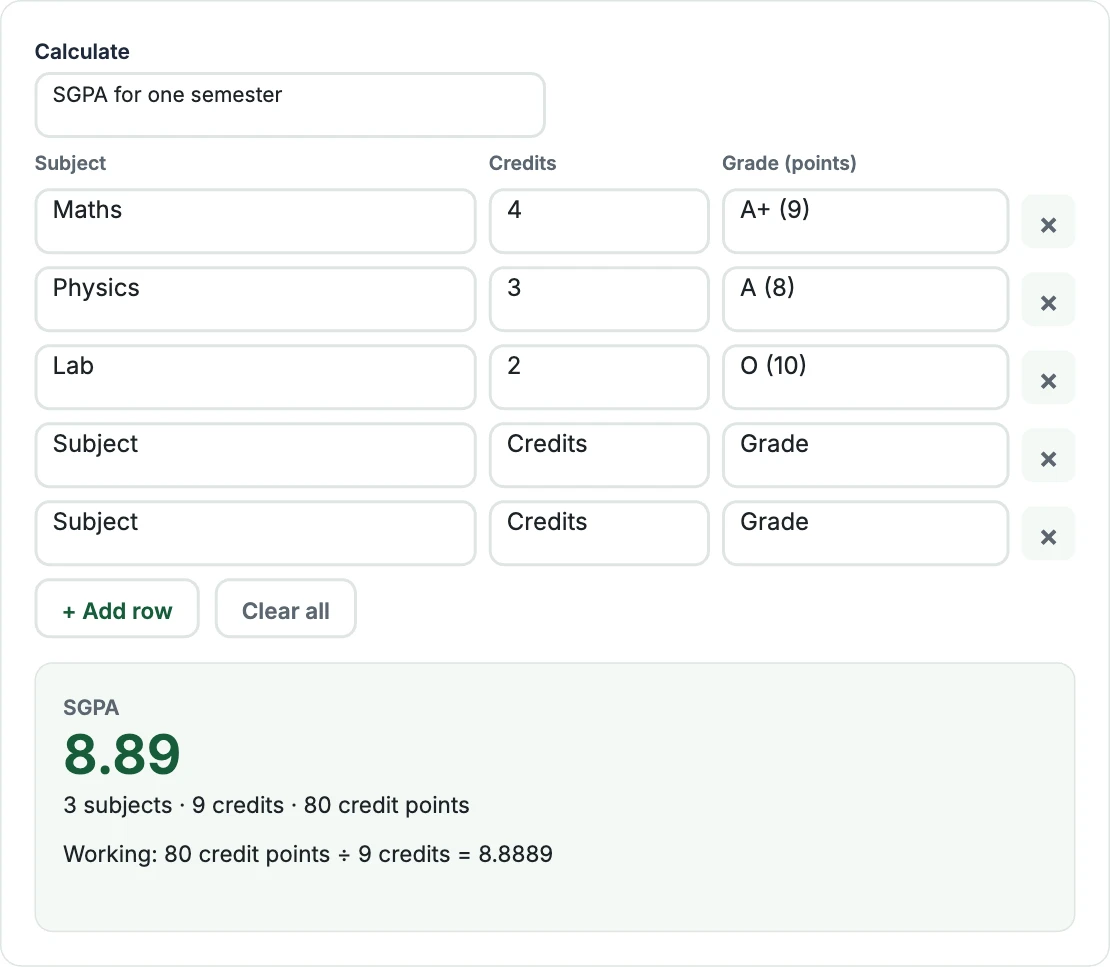
Indian universities that follow the UGC choice-based credit system use a 10-point scale: O = 10, A+ = 9, A = 8, B+ = 7, B = 6, C = 5, P = 4 and F = 0. Your SGPA for a semester is the credit-weighted average of your grade points:
SGPA = Σ(credits × grade points) ÷ Σ credits
Maths (4 credits, A+), Physics (3 credits, A) and a lab (2 credits, O) give (36 + 24 + 20) ÷ 9 = 8.89. Your CGPA is the same idea across semesters: multiply each SGPA by that semester’s credits, add them and divide by the total credits. If every semester has the same credits, it is simply the average of your SGPAs.
The SGPA and CGPA calculator does both, and flags a failed subject, which many universities leave out of the SGPA until the backlog is cleared.
6. How to convert CGPA to percentage
There is no single national formula. CBSE and many universities multiply by 9.5, so 8.2 CGPA is 77.9%. AICTE colleges and VTU use (CGPA − 0.75) × 10, which gives 74.5% for the same CGPA, and Mumbai University uses 7.1 × CGPA + 11. Use the formula on the back of your mark sheet; the CGPA to percentage converter covers the common ones and works in reverse too.
For a percentage of marks across subjects, add the marks you got, divide by the maximum marks and multiply by 100: 412 out of 500 is 82.4%. The percentage calculator handles that and percentage change.
7. How to calculate attendance percentage
Attendance is classes attended ÷ classes held × 100. Most Indian colleges need 75%, often per subject. If you are at 42 out of 60 (70%), you need to attend the next 12 classes in a row to get back to 75%, because (0.75 × 60 − 42) ÷ 0.25 = 12.
If you are above 75%, you can miss attended ÷ 0.75 − held classes. The attendance calculator does both, and tells you whether 75% is still reachable with the classes left this term.
Common mistakes to avoid
- Averaging percentages from tests of different lengths. 9/10 and 60/100 average to 75% as percentages, but you actually scored 69 out of 110, which is 62.7%. Weight by marks or by the syllabus weights.
- Forgetting credits. A 4-credit A counts for more than a 1-credit A. A plain average of letter grades is not your GPA.
- Using the wrong conversion. CGPA × 9.5 is not universal. Employers and colleges accept the formula your university publishes.
- Rounding too early. Keep two decimals until the end. Rounding every test to a whole number first can shift the result by a point, which matters right at a boundary such as 89.5%.
How grades compare: two reference points
In the US, the average high school GPA was 3.11 for the class of 2019, according to the National Assessment Governing Board’s High School Transcript Study. In India, most universities follow the UGC’s 10-point scale from its Choice Based Credit System guidelines: O = 10, A+ = 9, A = 8, B+ = 7, B = 6, C = 5, P = 4 and F = 0, with SGPA and CGPA worked out as credit-weighted averages of those points.
Frequently asked questions
Is a percentage the same as a grade?
No. The percentage is your score; the grade is the band it falls in. 85% is a B on the common US scale but an O or A+ on many Indian 10-point scales, depending on the university, so always check which scale your school uses.
What is a good GPA or CGPA?
In the US, 3.0 is a solid B average and 3.5 or above is strong. In India, many companies set placement cut-offs between 6.0 and 7.0 CGPA, and 8.0 or more is considered very good.
Can my GPA go up a lot in one semester?
It gets harder each term, because the new grades are averaged with more credits. After 60 credits at 3.0, a perfect 4.0 over 15 more credits only lifts you to 3.2.
How accurate are online grade calculators?
The maths is exact, but the result is only as good as the weights and scale you enter. Use the weights from your syllabus and the grade scale from your school or university.
All of these calculators are free, need no sign-up and work on your phone. You can find them, along with percentage, EMI and GST calculators, on the calculators page.
Sources
Checked in November 2026: